

Special Investigation: Ohio State aborted planned moment of silence after Charlie Kirk's killing
Public records show Ohio State scrapped a moment of silence that one university dean thought would spark public criticism—hours after The Rooster accurately reported the plan.

On Sept. 12, at roughly 6:30 p.m. The Rooster reported that Ohio State was expected to observe a moment of silence for slain conservative podcaster Charlie Kirk before the following day’s football game kickoff against Ohio University.
The tip came from a credible university source with a documented track record of accurate information, including the previous week’s revamped gameday schedule.
Ohio State spokesperson Ben Johnson called it a “false rumor” in a statement to NBC4’s Kyle Beachy. The following day, Ohio State president Ted “Slapshot” Carter told at least one Franklin County elected official that the university had no such plan.
The Rooster stood by its reporting the following Monday, noting that, if there was no planned moment of silence as the university claimed, it was curious that the color guard mistakenly lowered the north endzone flag to half-mast during Script Ohio.
As noted in that post, The Rooster retained Special Investigator Max Littman to prosecute the public records request for public consumption.
Here are his findings…
Given Ohio State’s notoriously slow response to records requests, which already led to The Rooster filing a successful lawsuit earlier this year, we were somewhat shocked when the university fulfilled our Charlie Kirk records request on Dec. 12.
As a gesture of transparency in our reporting, The Rooster offers that document dump in full:

In short, the public records reveal a planned moment of silence that at least one high-ranking university employee predicted would “likely” prompt public criticism.
That plan was seemingly aborted hours after The Rooster broke the story about Ohio State’s expected moment of silence for Charlie Kirk.
The saga starts on Thursday, Sept. 11, at 12:24 p.m.
Commander Jeff Heilman, executive officer of NROTC at Ohio State, emailed Erick Hoon, Associate Director of Athletics for Event Management and Assistant Vice Provost Cullen about a “rumor” about the university possibly lowering its flag to half-mast for Saturday’s football game.
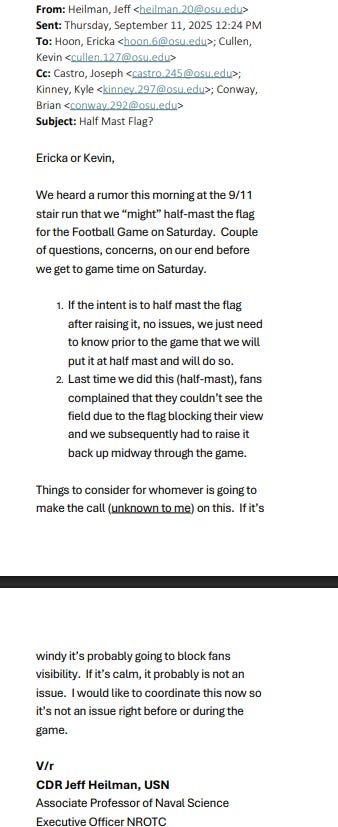
In her response, Hoon seemed to intentionally dance around who, exactly, Ohio State planned to honor:
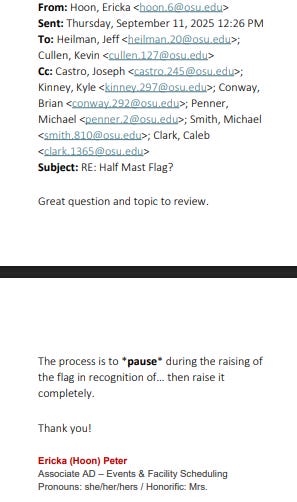
Commander Heilman was quick to let Hoon know that her plan did not conform to standard military protocol.
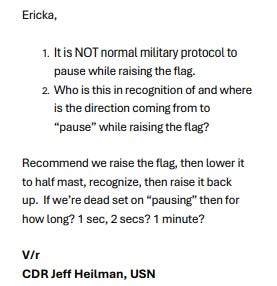
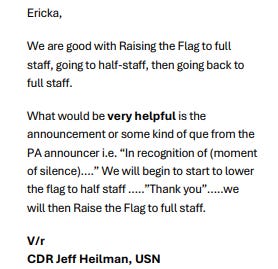
After a bit of back-and-forth, Commander Heilman noted that it would be very helpful (emphasis his) if the public address announcer informed the 100,000+ attendees about the lowering of the flag and the planned moment of silence.
Roughly 90 minutes later, Associate Athletics Director Caleb Clark wrote to the Ohio Stadium public address announcer Wesley Clark that it “sounds like” the flags would be lowered in remembrance of 9-11 and that he “didn’t believe” there would be a moment of silence.
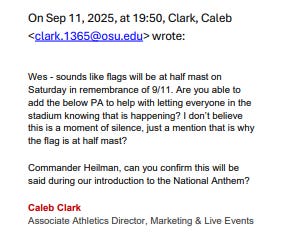
Clark’s non-commital language stood in contrast to simple facts: President Donald Trump and Governor Mike DeWine lowered the flags for Kirk, and Ohio State hadn’t observed the tragedy of 9-11 since the first home game after the attacks in 2011.
The 24th anniversary of 9-11, which isn’t a round number to mark a particularly notable passage of time, had already occurred two days before the scheduled kickoff.
And given the date of the tragedy doesn’t change, why would Ohio State officials be scrambling to solidify a planned observance the day before the game, if that’s what they were doing?
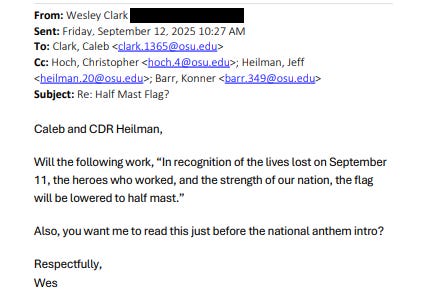
Nevertheless, public address announcer Wesley Clark dutifully wrote a script that referenced the terrorist attacks of 9-11 that he submitted the following morning:
Meanwhile, late Thursday night, Chris Kabourek, an Ohio State Vice President and senior advisor to President Slapshot Carter, emailed Norman Jones, Dean of Undergraduate Education and Kevin Cullen, Director of Military & Veteran Services, about Ohio Stadium’s half-mast policy.
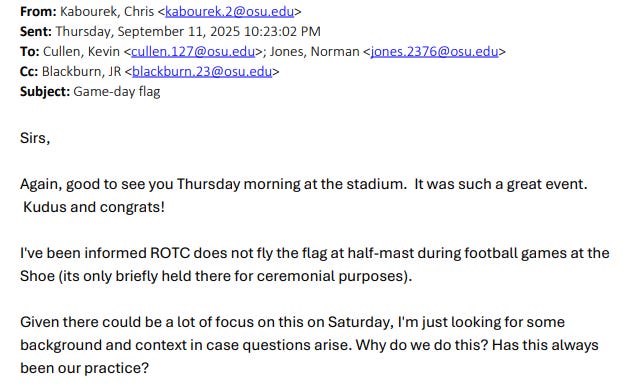
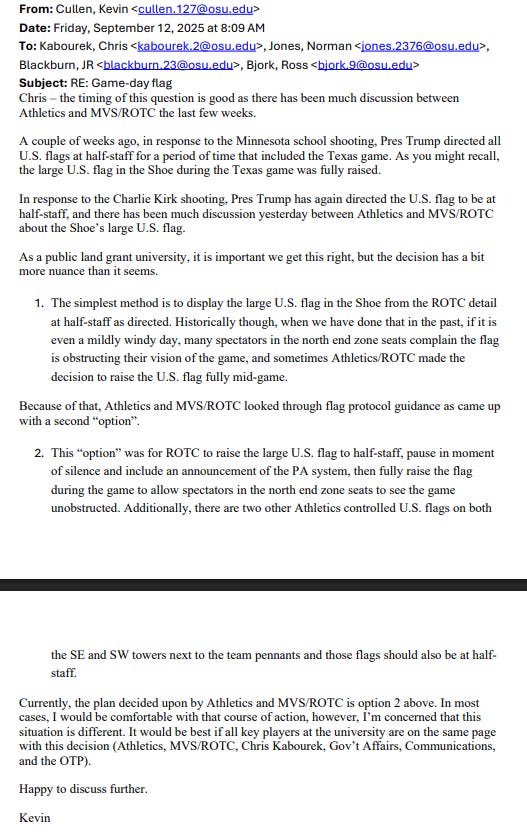
In an email the following morning, Cullen directly referenced President Trump’s request to lower the flags to half-mast in respect of Kirk.
He presented two options:
Option 1, which seemed horrible for any fans behind the flag.
Option 2, which included a moment of silence.
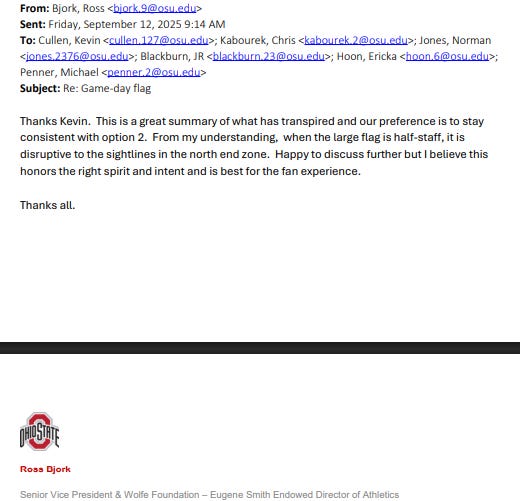
Roughly an hour later, at 9:14 a.m. Friday morning, Ohio State athletic director Ross Bjork selected Option 2 and the moment of silence.
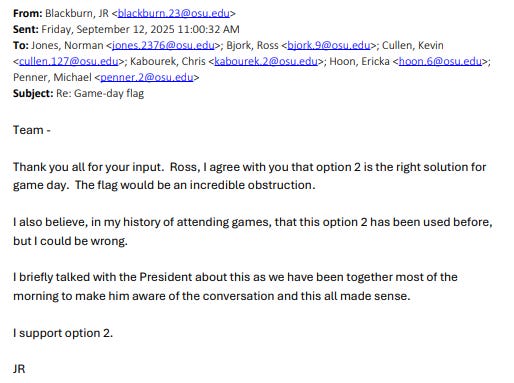
Two hours later, J.R. Blackburn, the Chief of Staff to President Slapshot Carter, agreed to Option 2, saying the president had been “made aware of the conversation” and that “this all made sense.”
In a prescient act of foreshadowing, Jones agreed with the decision but noted that he suspected “the university is likely to get criticized for any of these options.”
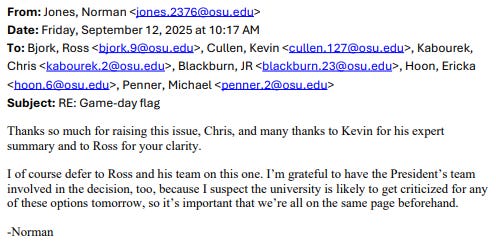
It’s unclear why Jones would expect public criticism of a moment of silence if that moment of silence honored 9/11 victims.
Hours later, Spokesman Johnson submitted a plan for the public address announcement that made no mention of 9-11:
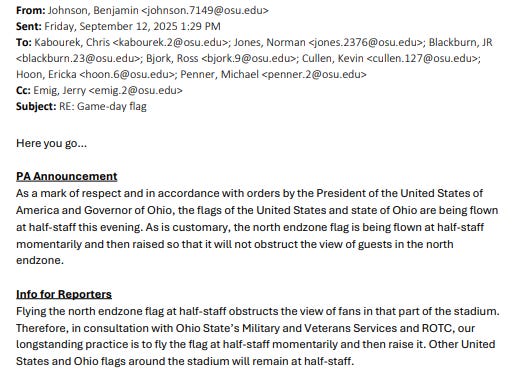
Johnson’s email also stood in contrast to the option already selected by President Slapshot Carter and Athletic Director Bjork, which included a moment of silence and a reference to a “mark of respect,” clearly intended for Kirk, given the concerns about public criticism.
Roughly five hours after Johnson hit “send” on that email, The Rooster broke the news about Ohio State planning a moment of silence for Kirk.
It’s from this point that it’s clear that multiple officials werr operating from differing playbooks about the moment of silence.
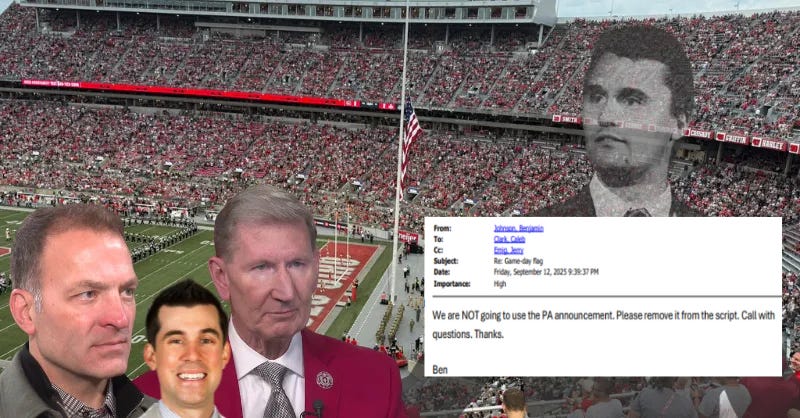
At 9:39 Friday evening, Spokesman Johnson sent a high-priority email to Caleb Clark, the university’s marketing director, claiming Ohio State would no longer use the public address system before kickoff.
“Call with any questions,” Johnson wrote, likely knowing phone calls aren’t susceptible to public records requests.
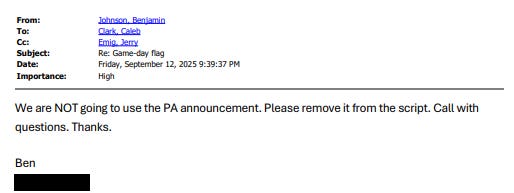
Two hours after Johnson claimed the public announcement had been scrapped, Ross Bjork, at a little past 11 p.m., wrote that, as planned, Ohio State would have to include a public address before the national anthem:
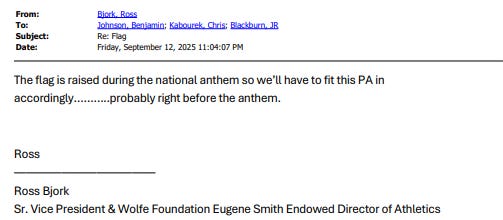
Sometime between 11:04 p.m. Friday and 7:30 p.m. Saturday, Ohio State officials reconciled the plan, apparently using lines of communication not susceptible to public records requests.
There was no moment of silence for Kirk before kickoff.
The only clue that something had been planned was, as The Rooster later reported, the university color guard accidentally lowering the north endzone’s flag to half-mast during “Script Ohio,” which deviated from standard gameday protocol.
From these emails, which show a scrambled, uncoordinated response from university officials into late Friday evening, we can draw several determinations:
When The Rooster broke the story, Ohio State’s highest officials had agreed to a public address announcement about the flags at half-mast.
Ohio State planned to have a “moment of silence” that showed a “mark of respect” for an unnamed honoree, for which one university dean predicted Ohio State would face public criticism.
For unknown reasons—and three hours after The Rooster reported on the planned moment of silence—Ohio State Spokesperson Ben Johnson cancelled the PA address.
A non-definitive statement from an associate athletic director led to Ohio State’s ROTC drafting a totally different public address that honored the victims of 9-11, an anniversary that had passed 48 hours prior and was never mentioned again.
Due to the lack of supporting documentation, we can’t claim that Ohio State cancelled the moment of silence because of The Rooster’s reporting or angry blowback from influential alumni.
In a statement to The Rooster, Ohio State spokesman Ben Johnson denied any planned moment of silence:
Flying the north endzone flag at half-staff obstructs the view of fans in the north endzone. When the president of the United States or governor of Ohio has ordered flags to be flown at half-staff, we typically lower the flag momentarily and then raise it.
In this case, there was also a conversation about whether or not we should make an announcement explaining why the flag doesn’t remain at half-staff. We have not made such an announcement in the past and ultimately decided to continue that approach.
As the records make clear, there was no planned moment of silence.
It’s here that we see why Johnson is a highly compensated communications professional. Nothing about that statement is incorrect or disputed… until the last sentence.
The records show that President Slapshot Carter and Athletic Director Bjork did, in fact, initially approve a plan that included a moment of silence that one university predicted would spark public criticism.
That plan remained in place until at least Friday night after 9 p.m., with Bjork apparently still believing it to be in place two hours later.
Anything else is arguing about irrelevant semantics, which, admittedly, is what Ohio State pays Johnson to do.
From an alumnus, thank you!
Thy gave you the docs quick cause its winter break and they figure you’ll report on this when the students are out and it will be forgotten. We’ll see if the Lantern does its job, doubtful.