

Inside the Ohio Democratic Congressional heist
Ohio Democrats walked away with a deal that would have seemed impossible as little as month ago. They can thank a "small group of people."

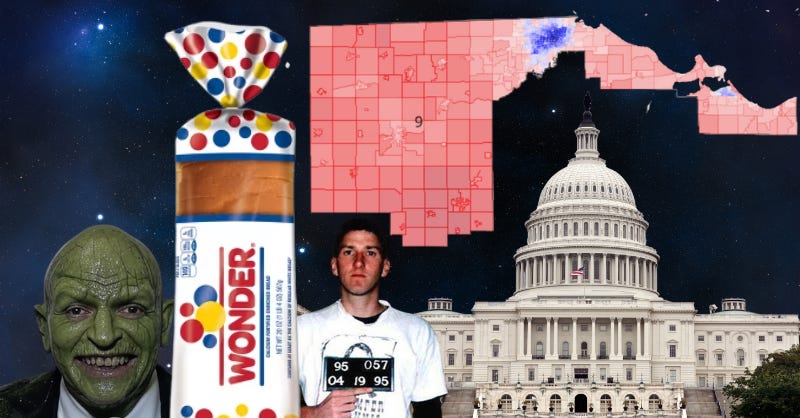
Last week, I suspected the worst when The Rooster broke the news that Ohio Democratic legislative leaders had struck a bipartisan deal for congressional maps.
But a funny thing happened after reviewing the map with a Republican source. My gut said it wasn’t a disaster—far from it, in fact.
That original feeling only solidified over the weekend after conversations with insider Republicans and Democrats who spoke to The Rooster on background.
I now have a firm belief that the Democrats agreed to a map that would have been dumb and reckless to disregard, given the national redistricting fight.
I understand that’s a tough pill to swallow for my activist friends who wanted to brawl. It’s not something that I write lightly.
Especially since House Minority Leader Dani Isaacsohn (D-Cincinnati) and Senate Minority Leader Tricky Nickie Antonio (D-Lakewood), by definition, enshrined a Republican-gerrymandered congressional map into state law until 2031.
A map that Republicans will be able to call “bipartisan,” despite only two Democrats in Ohio agreeing to the deal.
Isaacsohn and Antonio didn’t cover themselves in glory at the vote meeting, either. Antonio stayed silent, and Isaacsohn offered feint, generic praise to the activists that had come from across Ohio to register their disgust.
As I wrote last week, any activist anger is righteous, justifiable, and understandable, and neither Democratic leader met the moment during the final voting meeting.
It was unsurprising, given that current Democratic leadership (on state and federal levels) doesn’t seem to understand the furor pulsating through the base of the party—not only at Trump, but at milquetoast Democrats who continue to conduct business as usual.
And this bipartisan deal, on its face, is business as usual.
It’s the product of Ohio’s faux anti-gerrymandering system, where seven (in this case, white) politicians can dictate legislative maps to a state of 11 million through negotiations that occur in secret until the last minute possible.
However, this system is the only one we have. And given the constraints and stacked deck arrayed against them, the Democrats delivered a map that they never thought possible until the last minute.
For that, they can thank Senate President Rob McColley and “a small group of people.”
Here’s what I’ve been able to glean through conversations with five sources with first-hand knowledge of the negotiations, the ad-hoc pressure campaign to torpedo the deal, and how the Republicans mustered a unanimous vote on a map that doesn’t meet their national needs:
Speaker Matt Huffman, who does not give a damn about federal redistricting, outsourced the gruntwork to Senate President McColley’s team.
In fact, according to sources on both sides, McColley’s team, led by Senate Chief of Staff John Barron and their de facto map guru, Budget Director Ray DiRossi, would send maps to Huffman, who then would present them to the Democrats.
U.S. House Minority Leader Hakeem Jeffries was bluffing about having financial backing for a statewide referendum effort already lined up. One top Democrat admitted that their team called Jeffries’ office and got him to say the magic words in order to “plant” the story in Punchbowl News.
The gambit worked like a charm. One House Republican told The Rooster on Sunday that Leader Jeffries had his Republican colleagues “running scared” over the potential referendum.
Curiously, however, Huffman admitted to the Democrats during negotiations that they would also have a solid legal case against a Republican-only map, which could have frozen the current map for two years during a protracted legal dispute.
Contrary to what I reported last week, Ohio Democratic Party Chairwoman Kathleen Clyde and “donor table” head Misha Barnes backed a referendum despite questions about funding, the reality of gathering 250,000 signatures throughout the winter, possible ratfucking from Secretary of State Frank LaRose, and the MAGA-fied Ohio Supreme Court looming to adjudicate a new map after a successful referendum.
Clyde and Barnes had ulterior motives for the referendum. They saw it as an easy way to weaponize volunteers for future Democratic campaigns, which helps explain Barnes blasting Isaacsohn and Antonio in a “cover your ass email” shortly after the vote. She stoked the angry sentiment for professional gain, despite knowing the inner contours of the deal better than almost anyone.
Isaacsohn is obviously denying The Rooster’s report on a side deal with Congresswoman Emilia Sykes in exchange for a future campaign favor from the influential Congressional Black Caucus. The problem for him is that Sykes’ team isn’t working as hard as he is in that regard.
Regardless, nobody disputes that Democrats had a choice between emboldening Sykes’ district or keeping Cincinnati Congressman Greg Landsman’s seat roughly the same.
Isaacsohn maintains that the optics of protecting a Black woman, rather than a white Jewish guy who is also from Cincinnati, was an easier sell to House Democratic colleagues.
Even setting aside Isaacsohn throwing his local Congressman under the bus, it was still a bold decision given that Sykes, despite being a Black woman, is the least effective Ohio Democrat on Capitol Hill for a list of reasons that would require another blog post.
Isaacsohn, a little naively, wanted Congressional Democrats, statehouse colleagues, and organized labor to publicly back the deal. He got none of that, with Congressman Landsman saying, “Don’t worry, Dani. I’m not going to fuck you,” after moments of silent reflection upon the demand.
Multiple Cincinnati sources confirm that Landsman, in fact, is trying to (figuratively) fuck Isaacsohn, with one Southwestern Ohio player advising Isaacsohn to “go into witness protection.”
While that feud could reverberate through Cincy politics for years to come, the consensus from one Democratic leader was that Landsman will be fine, “even if he has to work a little harder” for re-election. And once Landsman secures that win next year, the leader predicted that any anger against Isaacsohn will dissipate.
In that vein, Isaacsohn also sought public statements from his House Democratic colleagues in southwestern Ohio. None of them agreed to that except for State Rep. Ashley Bryant, whom Isaacsohn just got appointed to the Ohio House via a backroom deal with Bryant’s sister, an influential member of the Hamilton County Democratic Party.
Never thinking a favorable deal was possible until it materialized, the Democratic consensus in the final weeks of negotiation was that no agreement was possible and that continuing to establish the requisite public record was necessary should the battle land in court.
That proved unnecessary when, in the final hours, Republicans shocked the Democrats by presenting a compromised map that didn’t cross any of their pre-stated red lines. It’s a map that becomes even more friendly when Donald Trump, a unique force in American politics, is removed from the partisan index.
Given the national redistricting fight and staring down the barrel of a potential 13R-2D map, national Democrats withdrew any support for a referendum. They pushed for an agreement, arguing that those two to three extra Democratic seats were an unforeseen bounty that could play a pivotal role in deciding control of the House of Representatives in 2026, and with it, American democracy.
So what changed? Why did Ohio Republicans balk at jamming a 13R-2D map down our throats, as U.S. Senator Bernie Moreno predicted they would earlier this year?
Why did they act like “a bunch of pussies,” as one Senate Republican quipped to The Rooster over the weekend?
For insight, we turn to Kevin Coughlin, who would have been the Republican candidate in the old 13th District if his party hadn’t abandoned him by redrawing the district in a way that assured national Republicans wouldn’t spend what’s needed to defeat Congresswoman Sykes.
The Rooster highlighted the most telling sentence in Coughlin’s statement:
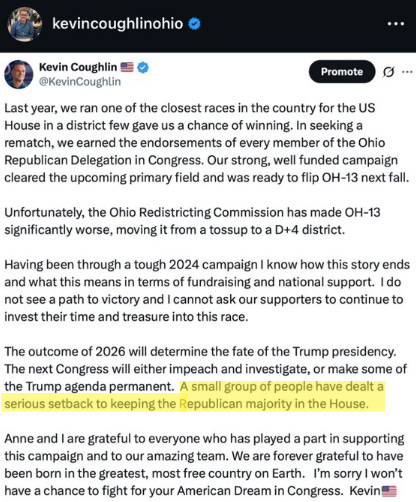
Coughlin is 100% right that “a small group of people” dealt a severe blow to Trump’s hopes of retaining the U.S. House of Representatives next year.
Outside of Congresswoman Marcy Kaptur in the 9th District, the 13th District was seen as the best pickup opportunity for Republicans, who would have spent accordingly.
In that district, they had a venerable candidate running for the second consecutive cycle after a marginal defeat in 2024. Republicans had the infrastructure and opposition research in place.
It was such a pivotal race that, roughly a month ago, Browns owner Jimmy Haslam threw a fundraiser for Coughlin. State Rep. Mike Dovilla (R-Berea) and State Senator Tom Patton (R-Strongsville) were listed as hosts and donors.
And the Republicans threw all that money and infrastructure in the trash in exchange for an ostensibly more winnable First District, where they will face a stiffer incumbent in Landsman and have no clear-cut candidate or party infrastructure in place.
It’s a decision that makes no strategic sense, unless you’re familiar with the aforementioned cabal of political perverts and their ultimate motivations.
Enter Senate President Rob McColley and the New 9th District
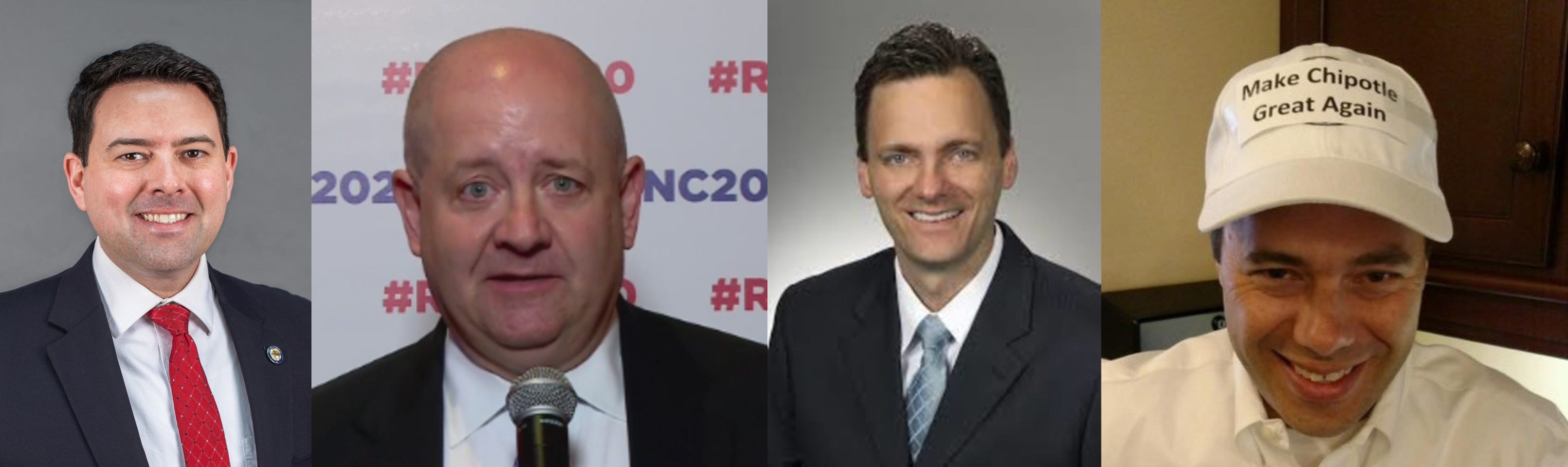
As The Rooster reported on Oct. 11, the political winds had shifted on Senate President Rob McColley in recent weeks.
Once seen as the likely Lieutenant Governor nominee on a ticket with Vivek Ramaswamy, McColley had been making covert moves to declare for Congress in Ohio’s Ninth District.
While nothing could stop him from running for the office while living outside the district, the scuttlebutt was that McColley would wait until his home turf of Henry County got added to the Ninth District in the latest redistricting cycle.
And wouldn’t you know it? That’s precisely what happened.
What shocked Democrats most during negotiations, aside from the final offer, was how hard their mapmaker, DiRossi, was trying to include as much of President McColley’s current legislative district as possible in the new 9th District.
It became clear to the Democratic team over the final days of negotiation that DiRossi cared more about adding McColley voters into the new Ninth District than increasing its Republican index—or seemingly anything else.
When the final map appeared, the Democratic braintrust surmised that they could accept a map that crossed none of their red lines in exchange for adding 90,000 McColley voters to the Ninth District.
Given the trade and the uncertainty of the referendum, which could still result in a 13R-2D map, the Democrats didn’t have to dwell on the matter for too long.
On the other side, that deal makes sense to McColley, as well as to current Republican congressional incumbents, all of whom had their safety maintained.
It does not, however, make any sense amid a national redistricting fight where two to three seats could determine control of the House of Representatives.
Jack Posobiec, a right-wing propagandist and conspiracy theorist who is treated as gospel by far-right Republicans, blasted the potential deal roughly 12 hours after The Rooster broke the news that Punchbowl News tried to claim as its own:
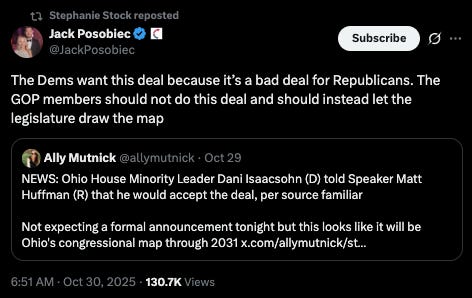
You’ll notice that anti-vaccine doofus Stephanie Stock echoed the sentiment, even if she incorrectly placed the blame at the doorstep of Speaker Huffman.
Democrats, meanwhile, fretted that Donald Trump could torpedo the deal with a single tweet. Those concerns were well placed.
While the White House knew a potential deal was in the works, they learned that Leader Isaacsohn accepted the deal when The Rooster broke the news.
National Republicans were understandably furious that their Republican supermajorities in Ohio balked at shoving a 13R-2D map through the legislature.
In fact, national Republicans pushed an alternate map, likely similar to the one Ohio Republicans had shown the Democratic leaders during negotiations, as a viable alternative to torpedo the deal.
That effort might have worked without longtime Republican hogbolin Bob Paduchick entering the fray.
As things stood in the waning hours of Oct. 30th, the seven-member Ohio Redistricting Commission likely had enough votes to pass the measure with Governor Mike DeWine, House Finance chairman Brian Stewart, and the two Democratic leaders.
But Republicans wanted a unanimous vote to give coverage to every party member involved.
So how did Auditor Keith Faber come around? Why did Secretary of State Frank LaRose and State Senator Jane Timken vote for a map that threw a certified candidate in Coughlin to the wolves and all but guaranteed a Democrat would represent their home towns of Copley and Canton?
The answer lies in Paduchick, who is seen as the Trump administration’s point person in Ohio. Paduchick used that credibility to extinguish the fears of MAGA blowback because he plans to consult for McColley’s nascent Congressional campaign.
Paduchick placed a call to Secretary LaRose, assuring him that the Trump Administration was on board.
He worked his long-standing relationship with Timken, a fellow former chair of the Ohio Republican Party, to assuage her concerns.
You might think a Secretary of State and State Senator on the verge of making a decision with national ramifications could place a call to Trump’s inner circle. But only a handful of Ohio politicians enjoy that luxury, and none of them sit on the Ohio Redistricting Commission.
That’s something Paduchick knew and easily exploited. He’s closer to the White House than any of them, and he used that credibility to snooker the potential holdouts by lying that the White House had signed off on the deal.
Trump, coincidentally, was being fêted in South Korea. His Vice President, J.D. Vance, lacking deep political roots in Ohio, doesn’t have enough juice on his own to stop someone like Speaker Huffman.
The same can be said about Ramaswamy, who didn’t even know the State Legislature had term limits until Huffman and McColley informed him of such during a meeting over the summer.
With the clock ticking and Ohio powerbrokers seemingly behind the deal, the alternative map died in the darkness, despite an agitated Auditor Faber referencing it when he went rogue against standing protocol and badgered a witness, claiming he had only seen the proposed map until “that morning.”
Why did the Republican junta agree to a map that thrilled Democrats?
When you weigh the perplexing decisions of the Republicans, all roads of explanation lead back to McColley and the “small group of people.”
For example, why did Huffman balk at the idea of having the current map frozen for two years before agreeing to another map that could yield the same 10R-5D congregation?
Was that crafty codger spooked by the thought of a protracted legal battle? Or, given what we now know, is it more likely he knew that using the current maps for two more years would destroy McColley’s best chance at winning a seat in Congress?
The bipartisan deal was the only way to prevent any uncertainty, and to achieve that, the Republicans had to offer a map with the particulars that didn’t violate any of the Democratic red lines.
Coincidentally, Republican leaders invoked the word “certainty” while defending their decision. But the only “certainty” their map guaranteed, beyond the re-election of incumbents, was that McColley would join an already crowded field for the Republican nomination in Ohio’s ninth district.
That field features State Rep. Josh Williams, former State Rep. Derek Merrin, and political newcomer Alea Nadeem.
The National Republican Congressional Committee (NRCC) doesn’t love any of them.
Williams would be a Black man campaigning in white, conservative places like Van Wert. It’s also suspected that there are quite a few skeletons in his closet.
While Merrin has the Holy Roller campaign apparatus thanks to his late father’s Baptist empire, he’s about as charismatic as a hobo’s half-eaten mayonnaise sandwich left sitting on a sidewalk during a hot summer day.
He also lost the last cycle to Kaptur because 20,000 Trump voters refused to vote for him.
Nadeem is something that Kaptur has never faced in the General Election: A woman.
However, she apparently led a DEI initiative under the Biden Administration while in the military, which gives her about as much chance as I have of winning the Republican primary.
McColley was long seen as the NRCC’s white whale, since national Republicans feel that the district’s political index isn’t the problem, but rather the recent lack of quality candidates.
McColley has never been accused of being exciting, and he’s never actually had to run a competitive General Election. But he is seen as a safe, vetted choice to face Kaptur in a bitter, competitive race that will demand tens of millions of dollars in national money on both sides.
McColley, however, isn’t from Lucas County, which is the bedrock of the district. And through that lens, it makes sense when his team sold national Republicans down the river in exchange for adding 90,000 McColley voters to the district as a way to juice his chances in the primary.
On Friday, I would have wagered a non-insignificant amount of money that Paduchick would grease the tracks to earn his client the “Complete & Total Endorsement” of President Business Deals.
In Ohio, no candidate has ever lost with that distinction.
But that surety has evaporated over the past 48 hours as more national Republicans learn the grisly details of why their side fumbled the bag.
The dirtiest deal ever?

One respected Republican source slid into my inbox on Saturday morning, stating that McColley had orchestrated “the dirtiest deal ever.”
And while I knew all roads led to McColley and his coterie of advisors, I hadn’t yet squared how he leveraged his interests above everyone else, other than the Congressional incumbents.
Never needing to be sold hard on Republican corruption at the Statehouse, I inquired for specifics multiple times. However, as of this writing at roughly 11 p.m. Sunday night, that source has yet to reply.
While I will continue to investigate the credible claim of corruption, the problem is that there’s a much simpler explanation for how President McColley leveraged his interests above those of the national Republican Party in Speaker Huffman.
Back when FirstEnergy was arraying its corporate forces to push the largest bribery scheme in state history (that we know about) through the State Legislature, lobbyist Ty Pine referred to Huffman as “transactional” when discussing the company’s efforts to funnel $300,000 to an independent expenditure group supporting Huffman.
In my opinion, that’s a euphemism for bribery. But there is no denying that Huffman is an old-school politician when it comes to maintaining his end of the bargain.
There are probably not many state leaders in America who could have held a bipartisan deal together through a secret national pressure campaign, even one lacking Trump’s full attention.
Huffman is one such leader.
While it’s not as spicy, the most likely scenario is that Huffman outsourced his duties to McColley as a final payoff to a faithful stooge who has allowed Huffman to control the Senate and House of Representatives in lockstep for the past 11 months.
Either way, the score is clear.
McColley and the Democrats won, while national Republicans walked away with a paltry haul despite holding all the cards in a state they’ve controlled for the past 14 years.
THOSE WMDs. The woman who wouldn’t stop having children… As Hong Kong waged a shadow war on in Britain, an ex-Marine became a casualty… The Candy Cane Murder was almost solved, but then… God’s Chief Justice… If Lizzie Borden didn’t kill her wealthy parents, who did?
Love this description of Merrin: "he’s about as charismatic as a hobo’s half-eaten mayonnaise sandwich left sitting on a sidewalk during a hot summer day.". Channeling HL Mencken
Amazing reporting. Thank you